
The terms Al-Kitāb and Al-Qur’ān are most often reduced to textual realities: a Book, a text, a sacred scripture.
Yet the Qur’anic language, when listened to in its depth, does not speak merely of texts—it speaks of missions, responsibilities, transmissions, and transformations of human consciousness.
This article proposes a reading that understands Al-Kitāb as revealed mission, and Al-Qur’ān as the living transmission of that mission. A reading rooted in prophetic continuity rather than rupture, and one that reflects on the passage from a mission received to a mission shared, from a consciousness gathered inwardly to a consciousness transmitted outwardly.
What follows is not a dogmatic definition, but a path of meaning, linguistic, spiritual, and existential, open to anyone attentive to the word, the breath, and the responsibility they carry.
Al-Kitāb: the mission that gathers
If Al-Kitāb is the mission, the revealed mission, then Al-Kitāb is the mission that brings everything together.
It is the universal mission, the integral mission.
Al-Kitāb is that integral mission which becomes reference, which becomes imām, which becomes leader—not guide, but leader in the sense of compass and direction. It becomes orientation: the orientation of all energies, all efforts, all inner impulses. This is the fundamental role of the mission.
Al-Kitāb is therefore not merely content.
It is what gathers.
It is what unifies.
It is what brings together all inner energies, all himmat, into a single muhimmat. It gathers all movements of the soul, all scattered impulses, and brings them into convergence around a single axis—a clear mission. Everything is drawn together. This is the role of Al-Kitāb.
Al-Qur’ān: the mission transmitted
Al-Qur’ān, by contrast, is transmission.
Al-Kitāb is the mission.
Al-Qur’ān is the transmission of that mission.
It is the moment when the Kitāb is carried, proclaimed, and shared.
Here, the distinction between Ahl al-Kitāb and Ahl al-Qur’ān becomes essential. It is not incidental.
In the Qur’an, the prophetic generations, the individuals and communities who entered into the covenants of the prophets before Muhammad, are referred to as Ahl al-Kitāb. By this, I mean : those who received a revealed mission.
They were entrusted with a mission.
A task.
A responsibility.
The responsibility to carry out their share of the work entrusted to them, in order to advance human consciousness, internally, and also in its external expressions : social, political, and civilizational.
From Muslim to Mu’min: a shift in consciousness
With Muhammad, something shifts.
We see clearly that the emphasis is no longer placed primarily on al-Islām and al-muslimūn, but on al-Īmān and al-mu’minīn. I am speaking here of Qur’anic terminology itself—and I wish to remind the reader that I am not relying on common or conventional definitions.
Those who entered into the covenant of Muhammad and committed themselves to his mission are described in the Qur’an as al-mu’minīn, not merely as muslimūn.
Īmān is not an identity or an affiliation.
It is a deeper engagement with Islām.
An active responsibility.
A mission.
Sharing Islām: peace, integrity, harmony
It must be made clear : this does not mean sharing Islām as a religion or a dogma, no.
It means sharing Islām as peace, as integrity, as a state of harmony, as we have previously translated it.
It means working toward universal peace and a global consciousness.
This is the deeper meaning of al-mu’minūn.
And this is why they deserve to be called Ahl al-Qur’ān, not merely Ahl al-Kitāb. This expression does not appear explicitly in the Qur’anic text, but it is clearly present in prophetic traditions: Ahl al-Qur’ān wa khāssatuh, and similar formulations.
Prophetic continuity: from received mission to shared mission
There is therefore a decisive passage.
From one era to another.
From one level of consciousness to another.
From one call to another.
A passage from Ahl al-Kitāb to Ahl al-Qur’ān.
But this passage is not a rupture.
It is a continuity.
A logical continuity.
After receiving the mission, after integrating it, embodying it, unifying it within oneself, al-Islām / Ahl al-Kitāb, comes the time of trans-mission. The time of Īmān / Ahl al-Qur’ān in the sense of sharing.
Sharing that Islām.
Sharing that peace.
Sharing that integrity.
The mission is no longer borne by a chosen people, nor by an elected community tasked with saving humanity.
It becomes a transmission of knowledge, a transmission of consciousness, a transmission of evolution, addressed to the whole world.
A trans-mission in the deepest sense: opening the mission to all, inviting others into the same horizon of consciousness, and offering empowerment—not domination, but responsibility.
This is how I understand Al-Qur’ān.
Linguistic confirmation: writing and reading as spiritual acts
This reading is also confirmed at the linguistic level.
The verb kataba, like qataba and rataba, fundamentally means to gather together, to organize, to unite what was previously separate. To create connection. To bring elements into a coherent orientation.
To gather knowledge.
To gather energies.
To gather ideas.
This is the meaning of kataba.
The Arabs knew this verb long before the practice of writing. They used it to express commitment, contractual binding, and unification. When the act of writing needed to be named, it was naturally this verb, kataba, that was chosen. Because to write is precisely to gather and unify.
Then comes qara’a.
Originally, qara’a meant to invite others, to receive them into one’s space, to welcome them, to share one’s food.
This is the verb the Arabic consciousness chose to express “reading.”
To read is to invite.
To read is to share.
To read is to transmit.
One first writes the mission.
Then one reads it aloud.
And in reading it, one transmits it.
Thus, Al-Kitāb is the mission.
And Al-Qur’ān is its transmission, the trans-mission :
the mission made universal.
Meditative Conclusion
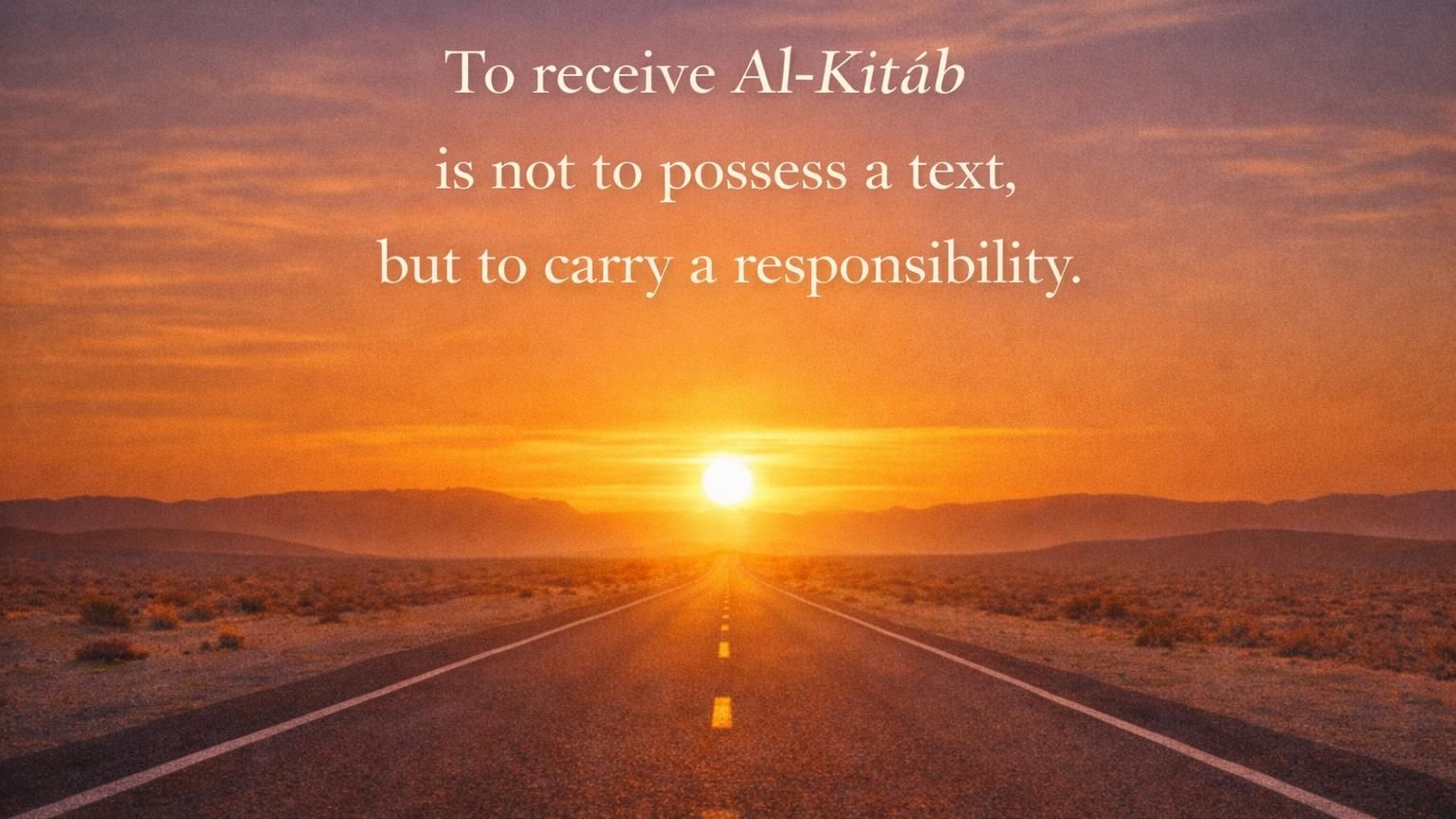
To receive Al-Kitāb is not to possess a text.
This is precisely what the Qur’an reproaches Ahl al-Kitāb for :
turning the mission into possession,
knowledge into capital,
and revelation into power.
They are reproached for withholding the text, for refusing to share it universally with al-mu’minīn, for clinging to a power of knowledge they sought to control others with rather than offer freely.
To receive Al-Kitāb is, on the contrary, to accept a mission that passes through us without belonging to us.
To be a bearer, not an owner.
A custodian, not a possessor.
To enter Al-Qur’ān is to cross that threshold.
To allow what has been unified within to be given.
Shared.
Transmitted.
Then the word ceases to be an instrument of power.
It becomes breath.
Invitation.
Responsibility.
The mission is no longer confined to a Book,
nor truth reserved for a community.
It becomes a shared horizon.
And transmission becomes an act of trust addressed to all of humanity.
Author’s Note
This text is part of an ongoing reflection on mission, transmission, and spiritual responsibility, grounded in Qur’anic language and its roots.
Arabic terms are intentionally preserved in order to maintain their semantic density and symbolic depth. The interpretations offered here do not belong to a dogmatic or confessional framework, but to a contemplative and reflective approach—one that seeks resonance between language, inner experience, and collective responsibility.
This perspective understands prophetic continuity not as a communal privilege, but as a universal invitation to the maturation of human consciousness, shared peace, and lucid engagement with the world.
Hamdi Ben Aissa
